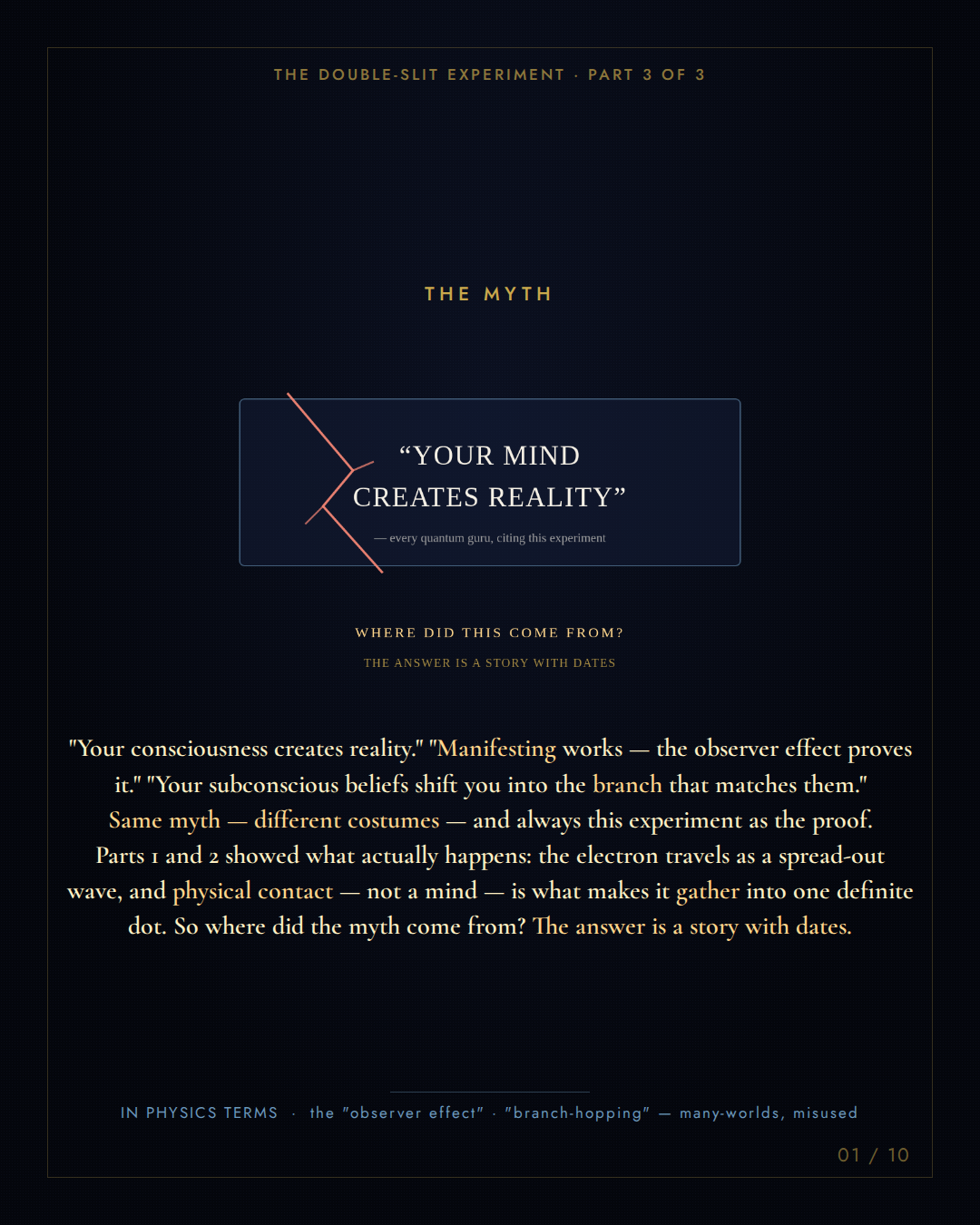
You have seen the double-slit experiment on your feed, and it was almost certainly explained wrong. The experiment is real, and genuinely strange. But it gets turned into “proof” that your consciousness creates reality — that your individual mind reaches down and calls the universe into being. That is the error.
Your consciousness does influence reality — the way one thing affects another thing inside the world. Real, but horizontal: a part of creation interacting with the rest of it. What the gurus claim is different. They take a power that could only belong to the very foundation of reality — a vertical power, the power that holds everything in being — and hand it to your personal mind. That is the sleight of hand.
And the strangest part: this experiment does not even show what they say it shows. It has nothing to do with your mind at all.
What follows is the experiment, honestly, in three passes. First the mystery. Then the mechanism. Then the paper trail — where the observer myth actually came from, and why it expired more than half a century ago.
The Mystery.
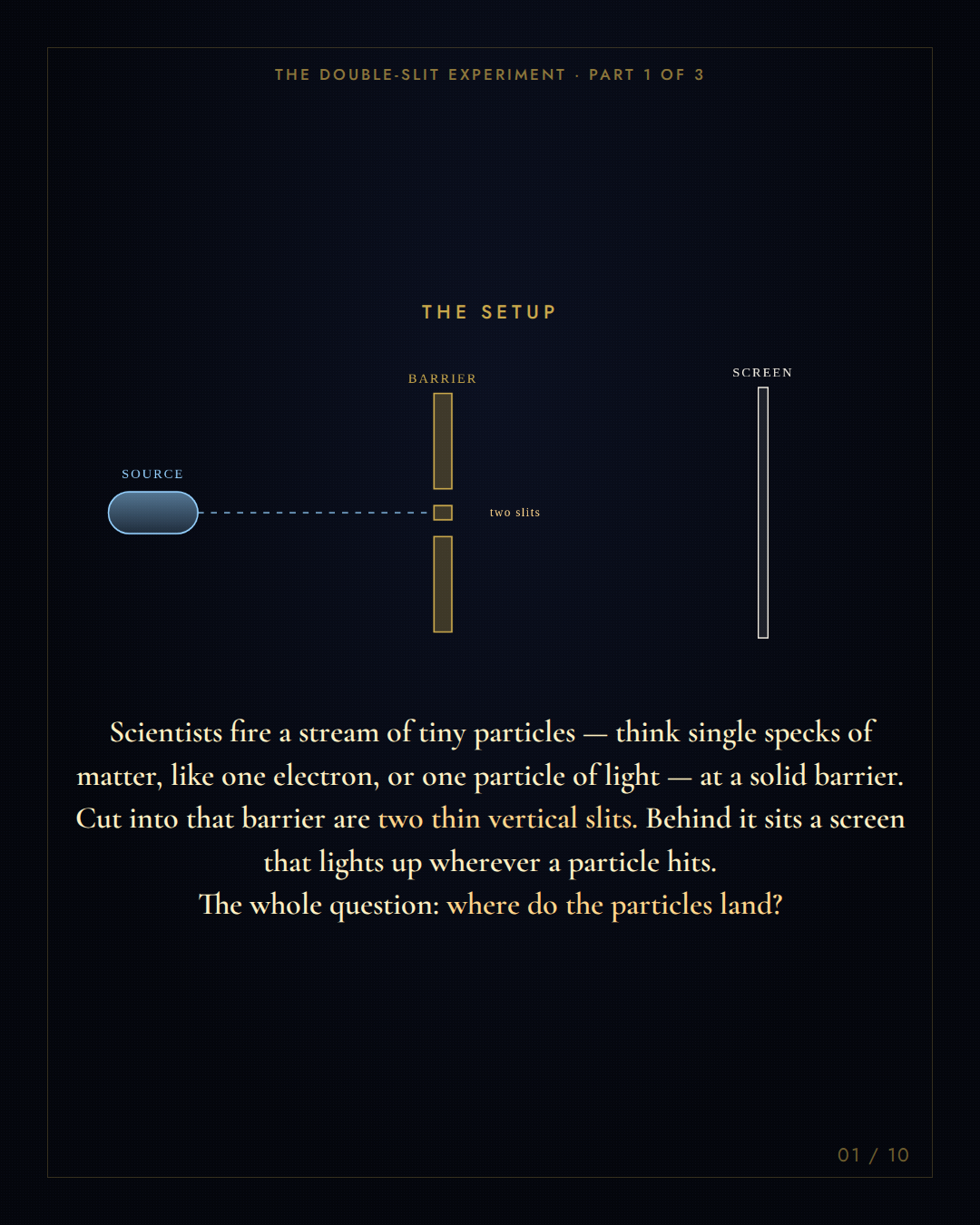
Fire single particles — think one electron, or one particle of light — at a solid barrier. Cut two thin vertical slits into that barrier. Behind it, place a screen that lights up wherever a particle hits. The whole question is: where do the particles land?
Cover one slit first, so only a single opening is left. The particles pass through and strike the screen in one bright strip, lined up right behind the open slit. Nothing surprising — this is exactly how you would expect tiny specks to behave. They go through the gap; they hit the wall behind it.
Now uncover both slits. If these particles really are tiny balls, like grains of sand thrown at a fence with two gaps, the answer seems obvious: two strips, one behind each slit. Two openings, two piles. Every instinct says this has to be the result.
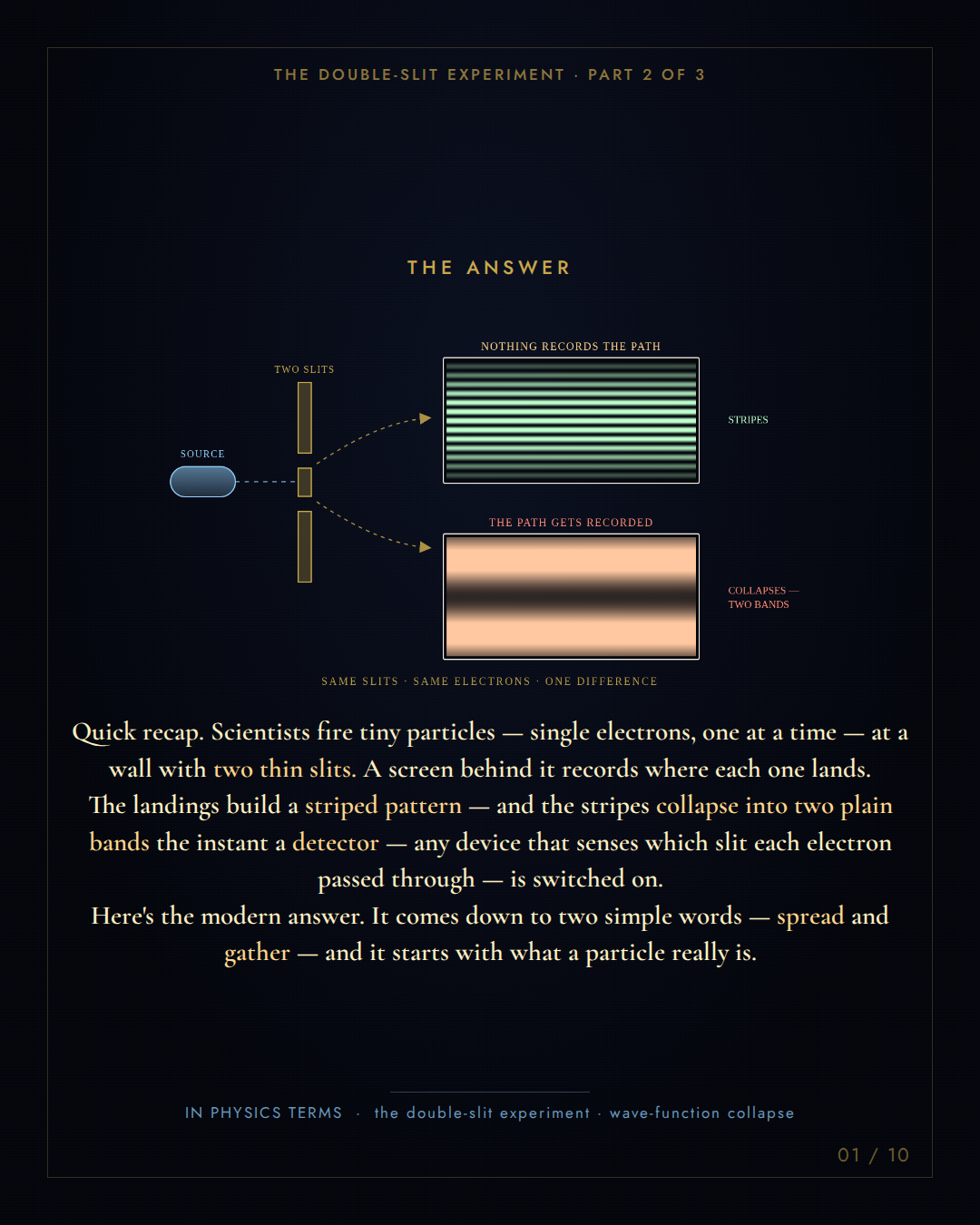
It isn't. The screen fills instead with many alternating bright and dark stripes, spread far wider than two slits could ever explain. Bright zones where nothing should have landed. Dark gaps where particles should be piling up. This spread of stripes has a name: an interference pattern.
For pieces of matter, this should be impossible. A striped pattern like this had only ever come, in the whole history of physics, from one thing: waves. Ripples on water. Sound. Light behaving as a wave. Never from solid particles you can count one at a time. That was the shock — matter appearing to behave like a wave.
Now the part that breaks intuition even further. Leave both slits open, but fire the particles one at a time, with long pauses between them — so that no two particles can ever meet in flight, or affect each other, or interfere with each other in any ordinary sense. Each still lands as a lone dot in a random-looking spot. But let thousands build up, and the striped pattern appears anyway. Each single particle, alone, somehow interfered with itself — as if it went through both slits at once.
So we try to catch it in the act. We place a detector at the slits that simply records which one each particle passes through. Nothing else about the setup changes. The screen is still there. The particles are still fired the same way. Only one thing is added: a record.
And the instant that path is recorded, the stripes collapse. Two plain bands. The wave behavior is gone. Read that again: path not recorded — wave behavior, striped pattern. Path recorded — particle behavior, two piles. Simply detecting which slit each one takes changes what it does.
So what is measurement doing? What is it about being recorded that changes the result? That is the real mystery, and it is where every honest reading of the experiment begins.
The Mechanism.
Physics knows exactly what is happening. It fits in two words: spread, and gather.
Spread. A particle is not a tiny ball. It is a field — an invisible ocean — gathered dense at one spot, like a whirlpool concentrated at a point. In flight, nothing is holding it together. So it spreads out into a ripple. That ripple is wide enough to flow through both slits at once and overlap itself on the other side. Where the crests of the overlapping ripple line up, they reinforce; where crest meets trough, they cancel. That overlap paints the striped pattern on the screen. Nothing has been added — nothing exotic, nothing mystical. This is what a single field looks like when it is spread and unimpeded.
Gather. Energy only moves in whole units. So when that ripple must hand its energy to the screen — must actually deliver itself — the whole thing condenses at one single point. It gathers. Every dot on the screen is one gather. The wave that spread is the same object as the particle that gathered. Two behaviors, one thing, in two situations.
Now the detector. A detector at the slit is a very different situation from the screen. The screen is where the energy is finally handed off, and something must gather to deliver it. The detector is a far gentler touch — one bounced speck of light is enough to record the path. It takes no energy from the field, so nothing has to condense. So the field still spreads. Both halves still make it through both slits.
Here is where the myth breaks. That single bounced speck is now a permanent record of the path. It carries away, in the language of the physics, the phase relationship between the two halves of the ripple. Without that shared phase, the two halves can no longer produce stripes when they overlap. They simply add: one solo pattern plus another solo pattern. Two plain bands.
The absolutely crucial point: this happens even if no human ever reads the record. Whether the recording device is watched by a person, sealed in a vault, or dropped into the sun immediately afterward, the pattern is the same — two bands. The physical fact of the recording is enough. The mind of anyone anywhere in the universe has no bearing on it whatsoever.
That is the whole answer. Contact — not consciousness. The collapse everyone talks about happens thousands of times per experiment with nobody watching. No human appears anywhere in this physics. So when someone tells you the double-slit proves your personal mind creates reality, you already have the 30-second answer:
“It spreads as a ripple. Contact makes it gather. A recorded path breaks the pattern — even unread. No mind appears anywhere in the physics. The real words for all of it: superposition, entanglement, decoherence. Look them up.”
Save this line. It handles nine-tenths of the internet's quantum mysticism in one breath.
The Paper Trail.
One honest question does remain, and it is worth naming. When the ripple gathers, where exactly it lands is a matter of pure probability. No hidden gear underneath predicts it. The physics gives odds, not certainty. That is a real feature of reality, and it is genuinely mysterious. But it is not the mystery the gurus are selling. The story of how a real question at the edge of physics got twisted into “your consciousness creates the universe” has a dated paper trail. Here it is.
The words first. In physics, observation is a technical term. It means any physical interaction that leaves a record: a photon bouncing off a particle, a detector clicking, a dot on a screen. The public heard the word and pictured a person watching. The entire myth lives inside that one misheard word.
The era. In 1932, John von Neumann showed that the math of quantum mechanics could not yet say where the spread wave becomes a definite dot — a genuine gap in the theory. In 1935, Erwin Schrödinger invented the cat thought experiment as a protest: an angry demonstration of how strange the theory looked while that gap was open. Schrödinger's cat was a complaint about an unfinished theory, not a discovery. In 1961, Eugene Wigner floated the speculation that maybe consciousness was what filled the gap. That is the line the gurus still quote. What they never quote is that Wigner himself later abandoned the view.
The answer. In 1970, H. Dieter Zeh showed — on the physics itself, working entirely inside standard quantum mechanics — that the gap closes as soon as you account for a system's interaction with its environment. Physical contact, not minds, is what kills the pattern. Through the 1980s, Wojciech Zurek and others developed the mechanism in full detail. It has a name: decoherence. It has been confirmed by experiment, over and over, in optics and cold atoms and superconducting circuits. It is standard physics now, in every graduate textbook.
And in 1998, science mailed itself a receipt on the whole business. On October 8 of that year, at Harvard University, Deepak Chopra was awarded the Ig Nobel Prize in Physics — the parody award — “for his unique interpretation of quantum physics as it applies to life, liberty, and the pursuit of economic happiness.” The Ig Nobel is what the scientific community hands out when a claim is popular but does not survive contact with the physics. It is documented, and it is dated.
So every “your beliefs collapse reality” reel you have ever scrolled past is quoting the question era as if it were the answer era. It is half a century late.
“But the delayed-choice quantum eraser proves the observer changes the past!” No. It does not. In that setup, each particle has an entangled partner. The stripes appear only when you sort the data afterward using the partner records. Nothing travels backward in time. No consciousness appears anywhere in the physics. Same mechanism as the original experiment, dressed in a fancier setup. Phase relationships determine interference, entanglement propagates those relationships, contact and record are what break them.
And here is what nobody sold you, because it is not saleable: the truth is more wonderful than the myth ever was. There is one field-substance beneath everything — a single fabric, not many. Form is held by motion; nothing static holds anything up. The future is genuinely open — not because your consciousness is bending it, but because the underlying odds are real odds. And through it all, at every level, you and everything else are being held in being, right now, this instant, level by level, all the way down to the quantum fields.
You don't create reality. Reality is creating you.
And the fields themselves — what is all of it in relationship with?
That is where the physics stops and Infinitely Simple begins.